
Identification Process
“When determining whether a child has a learning disability, a local educational agency shall not be required to consider whether a child has a severe discrepancy between achievement and intellectual ability…a local educational agency may use a process that determines if the child responds to a scientific, research-based intervention as a part of the evaluation procedures.” Additionally, “A child shall not be identified to be a child with a disability if the determinant factor is lack of appropriate instruction in reading, including the essential components of reading instruction (as defined in section 1208 (3) of the Elementary and Secondary Education Act of 1965).
Primary Focus: Learning interventions (academics and behavior).
Scope: Target individual student learning needs by implementing research-based interventions; use data to assess effectiveness; make adjustments to interventions that may involve a change in frequency, duration, intensity; and recommend consideration for a Tier-3 special education evaluation.
Relationship: A school-based team that supports teachers and partners with parents to address learning challenges of students. MTSS is the process (tiered model of intervention) that Ascent applies when teachers and educational support specialists begin to see learning challenges. Ascent rarely jumps first to the hypothesis that a child has a disability.

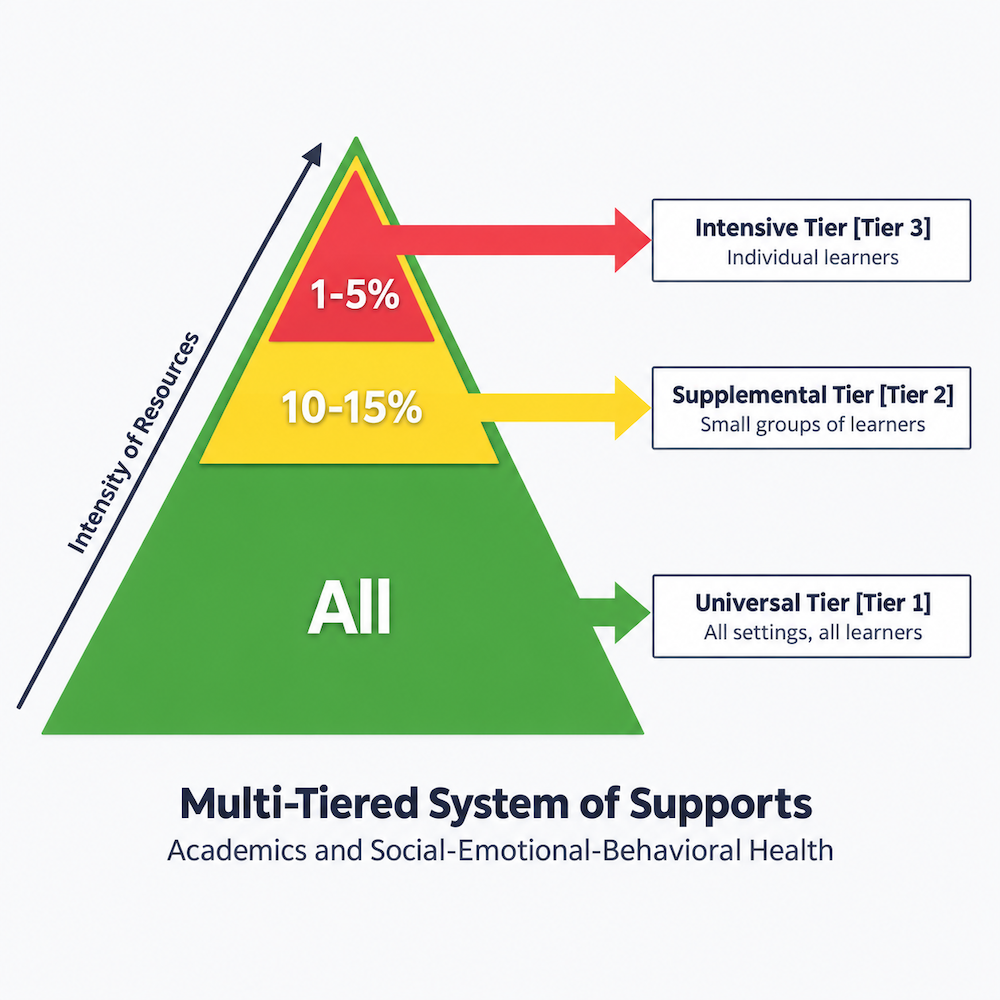
MTSS Teams
K-grade 6: This team includes learning specialists and school leadership.The focus is on early intervention. Classroom teachers apply the curriculum, assess student progress, collect and analyze data, make appropriate adjustments to instruction based upon data, provide differentiated instructional support, and network with teaching peers, Deans, and other school-based educational specialists when concerns arise in academic and behavioral learning.
Grade 7-12: The focus is to proactively teach the student their responsibility for learning. Classroom teachers monitor progress toward learning objectives and behavioral expectations. They collect data on student performance. Data collected typically includes:
- Grades on quizzes, tests, projects
- Assignment timelines
- Class participation
- Participation in group activities
- Response to teacher support
- Attendance
- Behavior management in the classroom and hallways
- Following classroom routines
- Parent communication